
The Food and Democracy Series (Spring 2026 Events)
The FJAR Lab has been proud to partner with the Food Studies Program and other units at The New School since 2022 to curate and host high-impact public events. These events have been an important part of our public-facing work.
In 2025-26, The FJAR Lab collaborated with the Food Studies Program at The New School and the university-wide strategic initiative on Democracy and Culture to present a year-long series on “Food and Democracy.”
In Spring 2026, the events of the Food and Democracy Series included:
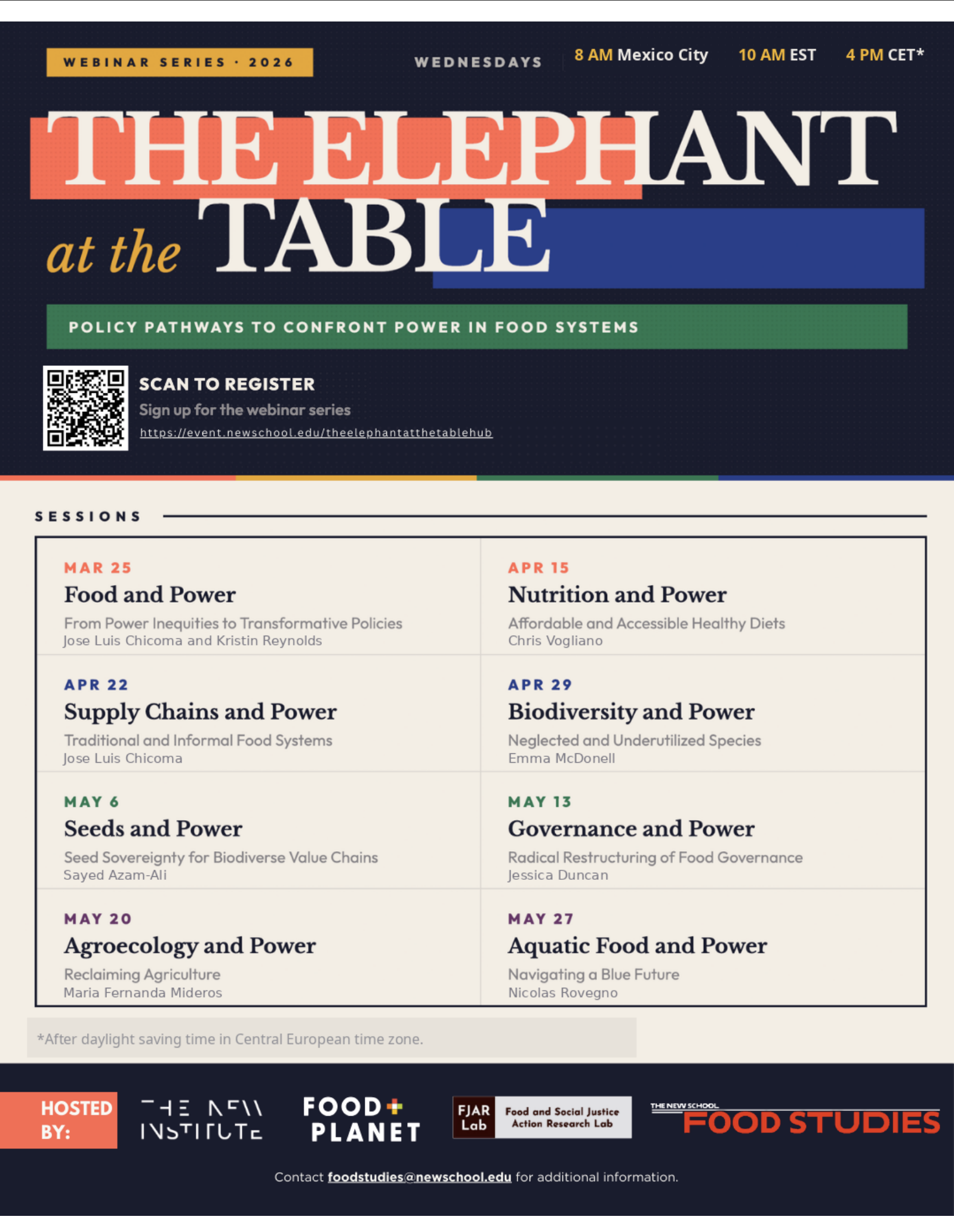
“The Elephant at the Table: Confronting Power in Food Systems Policy,” a webinar series, March 25-May 27, 2026
Food systems are shaped by power - by who controls resources, who sets the rules, and whose interests are protected. When power is ignored, efforts to improve sustainability, nutrition, and equity remain marginal and fragile. In this series, we examine how meaningful food systems transformation depends on confronting power directly: redistributing control over land, water, and seeds; reducing corporate concentration; reclaiming public and collective responsibility for food access; and challenging policy narratives that normalize unsustainability, exclusion, and inequity. We explored these themes in this webinar series running each Wednesday at 10 am eastern from March 25th through May 27th, 2026.
Across eight sessions, we presented and discussed an overarching analysis of power - focused on control over resources, governance, and corporate concentration - together with focused discussions across agroecology, fisheries and aquaculture, neglected and underutilized species, supply chains, nutrition, seeds, and governance. Each session illustrated how transformative change depends on shifting power and how similar analysis can be applied to policy across the food system.
The webinar series was also hosted by Food + Planet and supported by The New Institute.
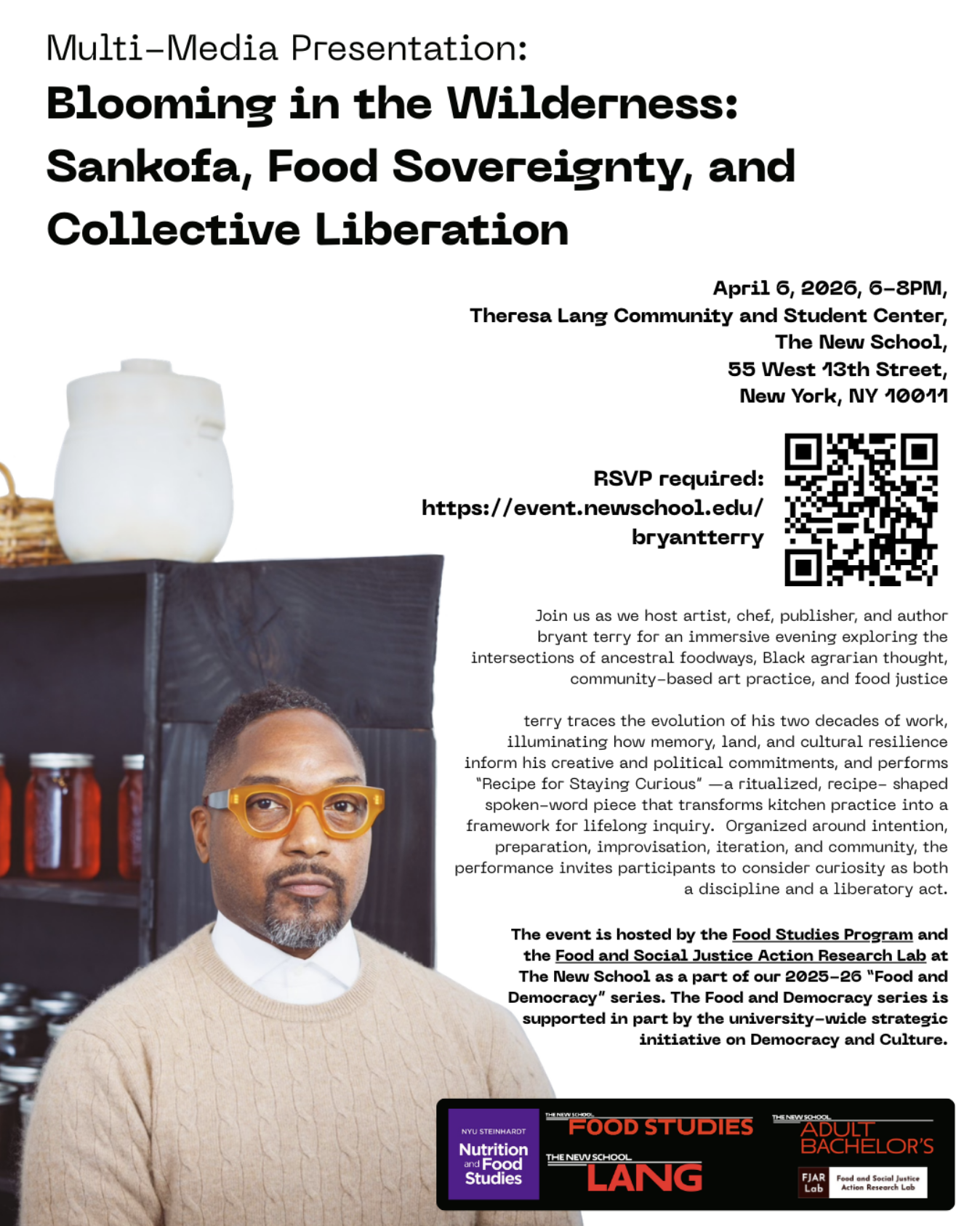
bryant terry - a multi-media discussion of food, art, and Black agrarian thought. April 6, 2026
The Food Studies Program, FJAR Lab, and the Department of Nutrition and Food Studies at New York University hosted artist, chef, publisher, and author bryant terry on April 6th for an immersive evening exploring the intersections of ancestral foodways, Black agrarian thought, community-based art practice, and food justice.
Terry opened with a talk tracing the evolution of his two decades of work, illuminating how memory, land, and cultural resilience inform his creative and political commitments. He then performed Recipe for Staying Curious—a ritualized, recipe-shaped spoken-word piece that transforms kitchen practice into a framework for lifelong inquiry. Organized around intention, preparation, improvisation, iteration, and community, the performance invited participants to consider curiosity as both a discipline and a liberatory act. Following the talk, attendees engaged in a sensory exploration of spices and herbs—some sourced from regional farms—using touch, scent, and sound. This interactive exercise, rooted in terry’s culinary and artistic methodologies, encouraged reflection on how sensory experience shapes memory, meaning, and our relationships to food and land.
The evening concluded with a book signing and book sales by BEM books and more, “the nation’s first Black food bookstore, café, and culinary hub,” located in Brooklyn. This event was a part of the FJAR Lab’s “Understanding Global Food and Environmental Justice through Music” Initiative, and was co-sponsored by the Department of Nutrition and Food Studies at New York University.
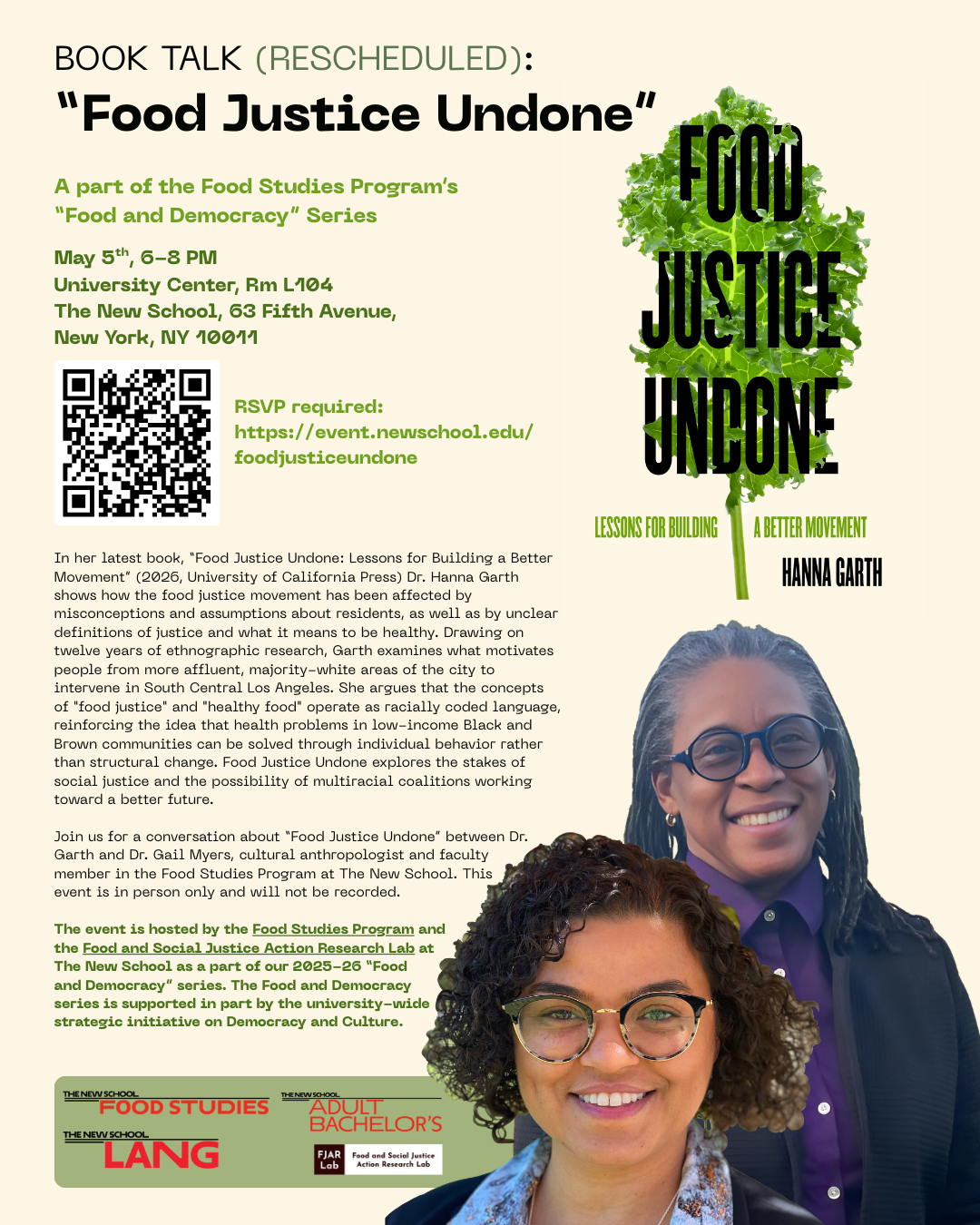
Food Justice Undone: Lessons for Building a Better Movement by Hanna Garth, May 5, 2026
Food justice activists have worked to increase access to healthy food in low-income communities of color across the United States. Yet despite their best intentions, they often perpetuate food access inequalities and racial stereotypes. In her latest book, Food Justice Undone: Lessons for Building a Better Movement (2026, University of California Press) Dr. Hanna Garth shows how the food justice movement has been affected by misconceptions and assumptions about residents, as well as by unclear definitions of justice and what it means to be healthy. Focusing on broad structures and microlevel processes, Garth reveals how power dynamics shape social justice movements in particular ways. Drawing on twelve years of ethnographic research, Food Justice Undone explores the stakes of social justice and the possibility of multiracial coalitions working toward a better future.
At this event at The New School on May 5th, we presented a conversation about Food Justice Undone between Dr. Garth and Dr. Gail Myers, cultural anthropologist, creator of the film project, “Rhythms of the Land,” Co-founder of Farms to Grow, Inc; and Part-Time Faculty in the Food Studies Program at The New School. True to the work of both Garth and Myers, the discussion was heartfelt and informative.